Before you order
Dishwasher spray arm not spinning? Check before replacing.
Work through loading, blocked jets, visible damage and water-circulation clues, then find a spray arm by your complete dishwasher model.
Start here
With the dishwasher off and cool, check whether a utensil blocks the arm, whether accessible jets or a user-cleanable filter are clogged, and whether the arm or its mounting point is visibly damaged. If these checks do not explain the problem, arrange circulation-system diagnosis before buying a replacement.
Jump to a section
Start with a safe, accessible check
Dirty dishes do not prove that a spray arm has stopped rotating. A utensil may obstruct it, debris may restrict the water path, or the problem may lie elsewhere. Work through the checks below in order of accessibility, not as a ranking of failure rates. Stop once you have a clear next step instead of ordering several speculative parts.
Let the dishwasher cool and disconnect electrical power before inspection. Follow your model manual for removing any user-serviceable component. Keep hands away from sharp debris, do not bypass the door switch and do not run the machine open to watch the arms. Stop for leaks, damaged wiring or uncertain access and arrange service.
1. Does the load block the arm?
With the machine off, check for tall pans, utensils hanging through the rack and items projecting into the arm’s path. Reposition them using the loading instructions for your model. Where the manual permits, gently turn the accessible arm by hand to check clearance; do not force it.
Check each accessible level separately. A clear lower arm does not establish that the upper arm is clear. If the obstruction is removed and the arm has no visible damage, replacement is not the next step. Reassemble everything and use a normal closed-door cycle according to the manual before deciding whether the wash problem remains.
2. Are jets or user-cleanable filters obstructed?
Look for visible food debris or mineral residue at accessible spray openings. Consult the manual before removing an arm: retaining clips, threaded fittings and removal directions differ. Clean only with methods approved for your model and avoid enlarging holes or damaging the surface with a sharp tool.
Check the filter if it is designated user-cleanable. A blocked filter can affect cleaning, and a clean-looking spray arm does not rule out a restriction elsewhere. Reinstall filters and arms in their proper positions before operation. Do not run the dishwasher with required components removed.
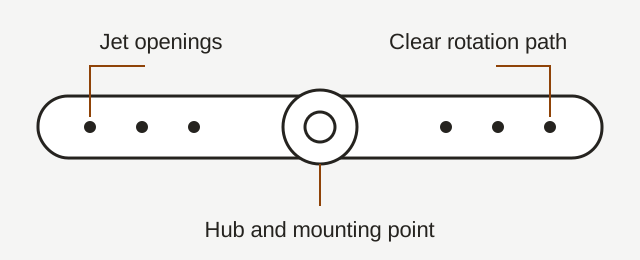
3. Is the arm cracked, loose or unable to seat?
Visible cracks, a damaged hub or a broken retaining feature give you a specific component to investigate. Identify whether the issue is in the arm, its mounting part or the feed connection. Photograph the damaged area and compare it with the complete-model diagram. A loose arm does not always mean the entire assembly is the correct purchase.
The catalog currently includes 5304517203 and WD22X33499, with the older WD22X27724 reference linked to the latter. They have separate model lists and are not interchangeable. The references below are starting points for a full-model check, not universal fixes.
4. Arm looks sound, but washing is still poor?
If loading and accessible cleaning do not resolve the issue, the water supply or circulation system may need assessment. Record whether the problem affects one rack or both, whether detergent remains in the cup and any displayed error code. These observations help a technician distinguish the water path from a dispenser problem.
Do not infer a failed pump or inlet valve from the arm position after a cycle. We have not documented those replacement references here, so this guide does not propose one. Use the model manual and qualified diagnosis before opening service compartments or buying a water-system component.
Brand-specific instructions matter
GE’s support guidance identifies inadequate filling as one possible cause of a lower or middle arm that does not rotate. Its loading advice also calls for checking that the arms can move freely. Those are different checks: solving a loading obstruction does not prove the fill system is healthy. Use the manual for your exact GE model before investigating water levels or access beyond the racks.
Bosch publishes separate maintenance instructions for filters and spray arms. The removal method is not universal across appliances, so do not transfer a twist-off or pull-off procedure from a video to a different model. Use the manufacturer instructions associated with your complete model and reinstall the components as directed.
Whirlpool’s loading instructions emphasize keeping both the spray path and detergent dispenser clear. The linked owner manual is an example for the models it covers, not a manual for every dishwasher. Our Frigidaire reference 5304517203 and GE reference WD22X33499 likewise apply only to their documented model lists.
Questions that help narrow the next check
Can an arm spin freely by hand and still have a problem? Yes. Clearance only checks for a mechanical obstruction; it does not prove water reaches the arm correctly during a cycle.
Does a closed detergent cup prove the spring is broken? No. The load, residue, latch or other dispenser components may be involved. Identify the mechanism in the model diagram before selecting a spring.
Should I replace both spray arms together? This guide does not assume that. Identify the damaged component and verify each replacement separately. A kit is appropriate only when its contents and full-model compatibility are supported.
Choose your next step
- Blocked by the load: reposition items, check clearance and reassess with the appliance reassembled.
- Debris found: use the model-approved cleaning procedure and reinstall all required components.
- Visible damage found: identify the exact diagram item and check the complete model on its part page.
- No clear cause or unsafe access: stop disassembly and provide your observations to a qualified technician.
Before ordering a spray arm
Copy the full model from the appliance label, including its suffix. Confirm the arm location, mounting arrangement, package contents and current replacement number with the retailer. A single-source result needs corroboration; an unknown result means the catalog has not reviewed that model. Neither is a reason to drop the suffix.
Check a documented part
Open the reference and enter your complete model. These parts are not universal replacements.
Sources to check
Reviewed October 21, 2026. Use the manual for your exact model; catalog information is not a physical fit test.
Editorial update: 2026-10-21